
Hunting Information
Hunting at Kennebunkport Conservation Trust
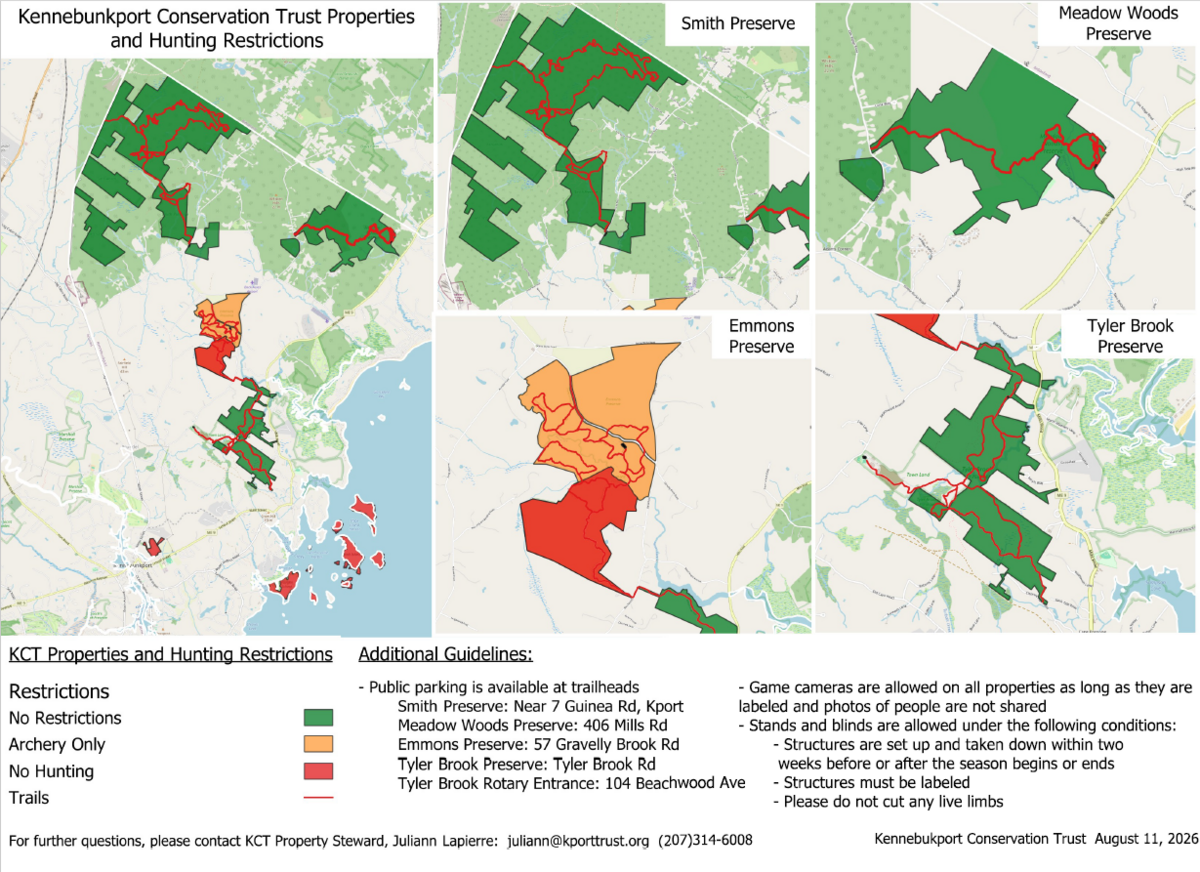
Kennebunkport Conservation Trust allows hunting on all of our properties except for James Wood. Please refer to the map below for specifics on restrictions.
When hunting at Emmons Preserve, we do have additional restrictions: only bow hunting is allowed on this property, and we do not allow hunting on or around the Learning Trail located on the west side of the Batson River across the large metal bridge.
If you have further questions after reading the information below, please contact KCT Property Steward Juliann Lapierre at Juliann@kporttrust.org.
We ask that all hunters:
- Do not hunt within 100ft of a trail or 300ft of a building, nor shoot in the direction of either
- We do not allow permanent tree stands or blinds.
- If you do choose to use a temporary stand or blind, you have two weeks on either side of the season to put up and take down equipment.
- Please do not cut any live limbs.
- We allow the use of game cameras, please do not share any photos of people if you capture any.
- Please tag and report the location of any equipment to Juliann Lapierre, Property Steward via email: juliann@kporttrust.org.
If you would like to hunt on KCT property, please fill out our Hunting Registration Form by clicking the button below.
Why is Hunting Important for Conservation?
When done safely and responsibly, hunting supports the conservation of wildlife and the ecosystems that support them.
Hunting can be used as a tool to regulate species that have overpopulated an area, often due to the absence of natural predators. Biologists establish species-specific limits to manage fast-growing populations, which also prevents the spread of disease, habitat damage, and starvation.
Through federal legislation such as the Pittman-Robertson Act and the Duck Stamp Act, funds from hunting licenses and equipment sales support conservation efforts, such as the expansion of protected wildlife habitat, educational programming, and access to outdoor recreation. In Maine, these funds go directly to the Maine Department of Inland Fisheries and Wildlife, supporting more than 120,000 acres of Wildlife Management Areas, creating habitat for moose, Canada lynx, white-tailed deer, and New England cottontail.
“In Maine, up to 75% of the salaries and essential operating costs of [MDIFW] research, conservation efforts, and regional management staff time related to wild mammals and birds are supported through PR funds. Were it not for PR funds, we essentially would not have management programs for white-tailed deer, moose, black bear, furbearers, wild turkeys, waterfowl and upland game, nor wildlife disease monitoring, Christmas bird counts, habitat programs with landowners, or Wildlife Management Areas” (Maine Department of Inland Fisheries and Wildlife).
To learn more about how conservation is supported by hunting, check out:
- https://www.wilderness.org/articles/blog/responsible-hunting-offers-significant-benefits-wildlife-conservation
- https://www.maine.gov/ifw/fish-wildlife/wildlife/support-wildlife/federal-aid.html
- https://www.maine.gov/ifw/hunting-trapping/hunting/benefits-of-hunting.html
To learn more about Maine’s hunting licenses and permits and purchase one online, visit:
https://www.maine.gov/ifw/hunting-trapping/hunting/laws-rules/licenses-permits.html
To familiarize yourself with Maine’s hunting seasons, visit:
https://www.maine.gov/ifw/hunting-trapping/hunting/laws-rules/season-dates-bag-limits.html